
By enabling faster and more accurate diagnoses, improving the patient journey, and facilitating data processing, artificial intelligence has the power to transform public health and individual care.
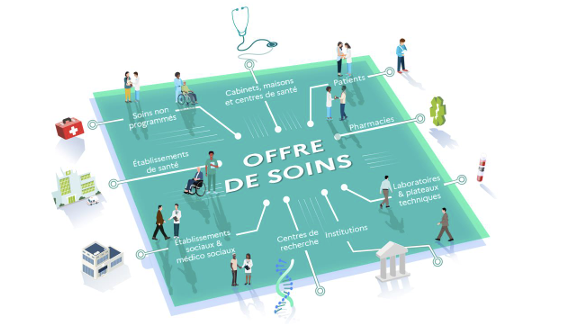
The mapping brings together the various stakeholders in the healthcare delivery system and identifies, for each of them, the areas for improvement through the use of AI, digital twins, the metaverse, and telehealth, as well as through public policy support. This evolving resource thus provides entrepreneurs in the digital health and e-health sectors with a clear perspective on current and future opportunities in the field, as illustrated by this summary:
From the perspective of healthcare professionals,healthcare facilities, private practices, and laboratories stand to gain significantly from digital technology. Artificial intelligence offers techniques that enable more accurate and reliable diagnoses. In this regard, Rennes University Hospital (CHU de Rennes) has developed an algorithm to improve the interpretation of MRI scans for prostate cancer. It provides additional, easier-to-read images in which abnormalities are clearly visible.
In medicine, digital advancements are making it possible to conduct remote consultations via telemedicine, for example, under increasingly sophisticated conditions, as demonstrated by the case of a patient treated at a hospital in China who underwent surgery for a kidney tumor performed by a surgeon operating from Bordeaux using a robot.
As for pharmacists, digitization helps them ensure the safe dispensing of medicinal products and optimize inventory management.
Moreover, AI and digital twins have already demonstrated their ability to accelerate the development of medicinal products by research centers. They enable faster identification and modeling of molecules, leading to the proposal of treatments.
From the patient’s perspective, digital tools ensure a more personalized care journey, from prevention through diagnosis to treatment follow-up. The use of AI by healthcare facilities also enables them to provide faster care through improved workflow management or pre-diagnostic systems. In the emergency department at Rennes University Hospital, a software that automatically reads X-rays within minutes when a fracture is suspected has reduced patient wait times by 30%.
Overall, digital technologies simplify administrative tasks and provide significant support for strategic decision-making. Generative AI, in particular, is a great help in planning staff schedules.
Healthcare institutions are making extensive use of digital technology and artificial intelligence to coordinate stakeholders within the healthcare system and improve policy management in line with the population’s actual needs. The use of advanced information systems also facilitates epidemiological surveillance and preparedness for public health emergencies. During the COVID-19 crisis, for example, AI was used to accelerate vaccine development.
This document serves as an essential resource enabling sector stakeholders to develop and deploy innovative solutions tailored to the needs of the healthcare system. The challenge remains to balance technological innovation with legal compliance to ensure ethical and secure implementation.
For more details, the roadmap is available via this link.
Written by Victoire LAGORCE